
October 15, 2026
How to Spot an Original Levoy Exil Painting
Original or print? A collector’s guide to buying an original Levoy Exil: signatures, provenance, red flags — and why the artist’s official gallery is safest.
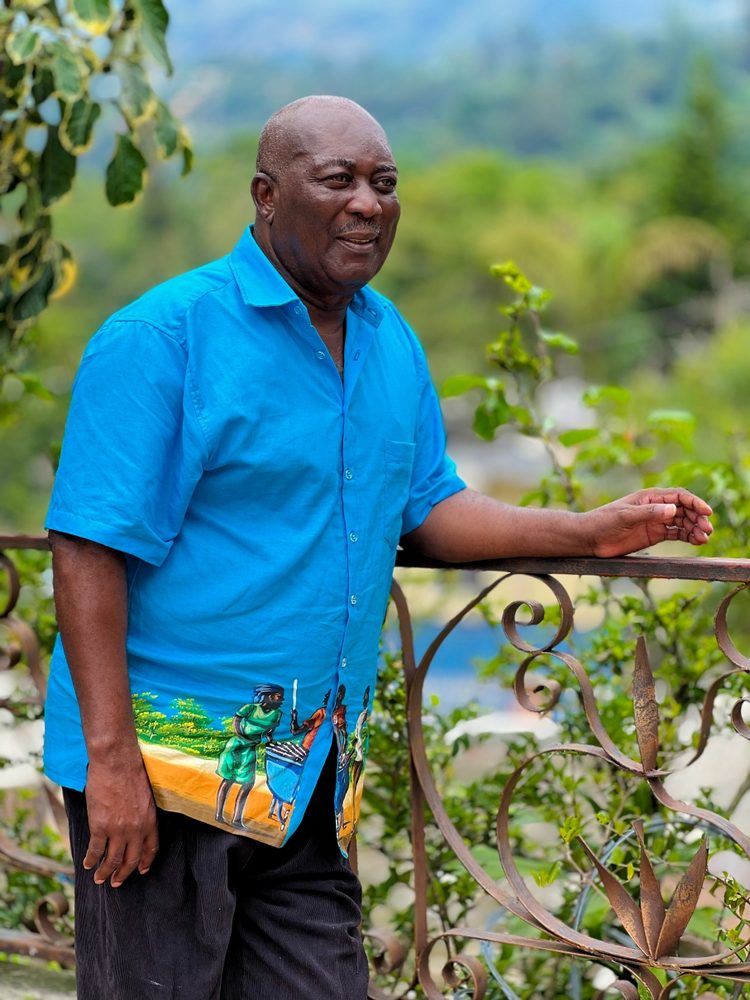
Are Levoy Exil’s paintings originals or prints?
Yes — every painting in this gallery is an original. Each work is hand-painted by Levoy Exil himself in his Fermathe studio: one of a kind, and never repeated. There are no prints sold as paintings here. What you see is the actual surface his brush touched, with the texture, layering, and density that only a real painting carries. When you buy Haitian paintings through the artist’s official gallery, you are acquiring the object itself — not a reproduction, not a copy, and not one of an edition. That single fact is the foundation of everything else in this guide. If a listing anywhere online cannot tell you clearly whether you are looking at the original or a reproduction, treat that as your first warning. Remember, too, that an original is the only version of the work that will ever exist — when it finds its wall, it is gone from the market for good.
What “original” means in this gallery
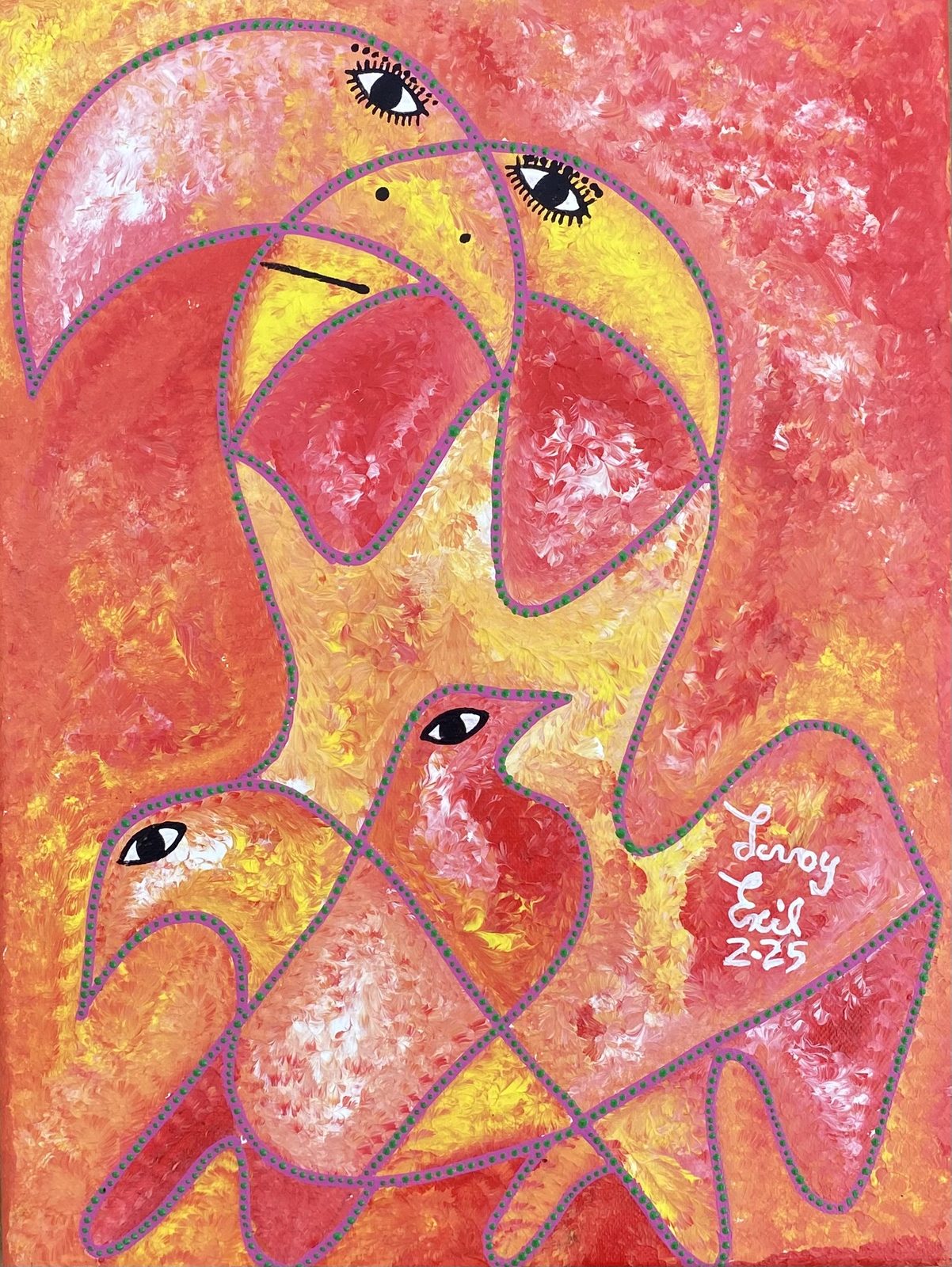
An original Haitian painting means the artist painted it by hand, and that no other identical work exists. Exil’s method — thousands of tiny dots building suns, Loas, and serpentine forms — cannot be mass-produced; each canvas is the record of long hours of concentrated work. The gallery lists one-of-one works only. If you are comparing Haitian art for sale elsewhere and wondering why prices differ, this is usually the first question to ask: is it the original, painted by the artist’s hand, or is it a print? The answer changes everything — the value, the presence on your wall, and what you one day pass on. Prints and editions have their place — but they are a different purchase, at a different price, with a different future. This guide is about the originals. That is why the gallery encourages close looking: an original rewards it, and a reproduction does not.
Look closely: the hand of the artist
You can train your eye before you buy. Ask the gallery for close-up photographs of the surface: in an original Levoy Exil, you will see the physical build-up of paint, the tiny individual dots, places where colors overlap and breathe. A print is flat by comparison — uniform ink on paper, identical at every edge. Originals carry small human variations no reproduction can fake: a dot slightly larger here, a color shifting there, the rhythm of a hand that never hurries. The gallery is always happy to send detailed photographs of any painting, so you can look as closely as if you were standing in front of it in Fermathe. Compare, when you can, with the gallery’s photographs of other originals: the family resemblance is in the hand, not in the image. When the detailed photographs arrive, look at them slowly, the way you would look at the painting itself: the original will keep giving; a reproduction gives everything away at once.
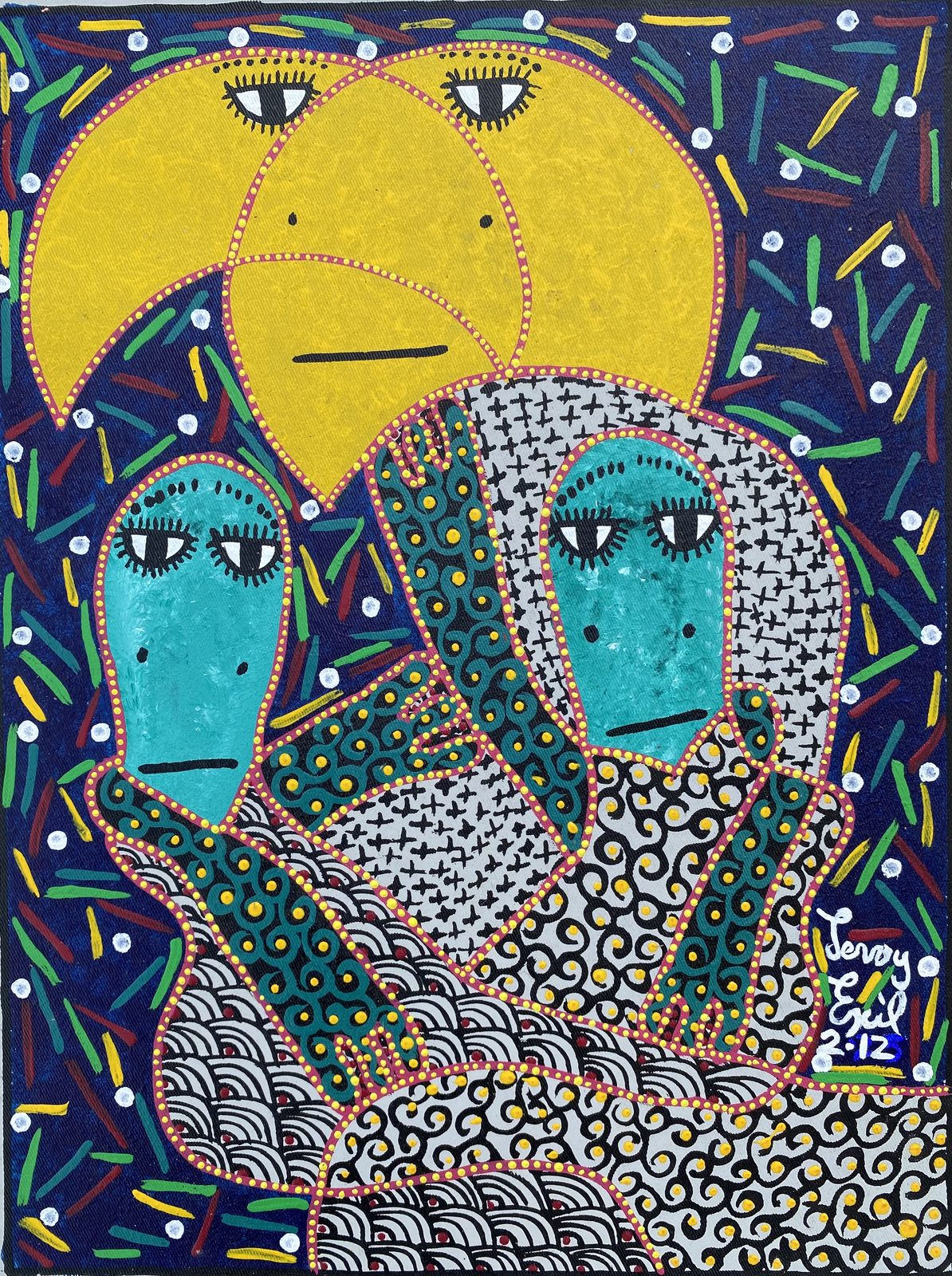
Signatures and the back of the work
Provenance is the quiet paperwork of the art world, and it matters. When considering an original Haitian painting, ask for a photograph of the signature and of the back of the work, and ask the gallery to confirm the painting’s history in writing: where it has been, who it came from, which collection it belonged to. A serious gallery answers these questions gladly. Exil’s exhibition record — more than fifty years of shows from Paris to Port-au-Prince — means many of his works carry real exhibition histories, and the gallery can tell you what is known about the piece you are considering. Get the story before you commit, not after. Keep whatever the gallery sends you — photographs, emails, receipts. Good provenance is a file you build, starting the day you buy. If a work once hung in a named exhibition — and many of Exil’s have, from Paris to Port-au-Prince — that history should be stated in writing, not just mentioned in passing.
Provenance: the story that travels with the painting
The market has already spoken on Exil’s originals. In June 2019, at Artcurial in Paris, a watercolor catalogued as Figure, dated 1975 — once in the personal collection of André Malraux himself — sold for €4,160, several times its estimate. Works with a documented story, especially ones connected to the Saint Soleil movement’s early years, are the ones collectors compete for. When you enquire, ask what the gallery knows about your painting’s journey: an original with a traceable past is worth more, and worth more securely, than a beautiful painting with no story at all. That result — €4,160 against a pre-sale estimate of €1,000 to €1,500 — tells you what the market does with originals that carry a story.
Where to buy an original safely
The safest place to buy Haitian paintings is from the artist’s own official gallery — in this case, this website, levoyexil.com, where every listed work is an original sold with the gallery’s backing. You can browse the full collection in the gallery, enquire by WhatsApp, or write to levoyexilgallery@gmail.com. Buy directly and you get three things a resale cannot promise: certainty about authenticity, the full story of the work, and a relationship with the people who know the artist’s practice best. For Haitian paintings for sale anywhere else online, apply every test in this guide before you spend a cent. When you buy Haitian paintings directly from the artist’s official gallery, there is no middleman to blur the story. Ask for the painting’s story in the same message in which you ask the price — a gallery that knows its artists will have both ready.
Red flags to watch for
A few warning signs apply across all Haitian art for sale. Be cautious of sellers who cannot show you photographs of the actual painting being offered — stock images or a single low-resolution photo are not enough. Be cautious of prices that seem impossible for an original by an established artist, and of sellers who go vague when you ask about provenance or the work’s history. And be wary of any listing that cannot tell you exactly which painting you are buying. Genuine galleries welcome scrutiny; if your questions are unwelcome, walk away. Trust the pattern: a legitimate seller’s answers get more specific the more you ask; a dishonest seller’s get vaguer. Finally, trust how the seller treats your questions: expertise welcomes them, and evasion is an answer in itself.
Shipping and care, anywhere in the world
Originals travel well when professionals pack them, and the gallery ships internationally — paintings are prepared for the journey so they arrive as they left the studio. Before your painting ships, ask the gallery about packing, insurance, and delivery times to your country, and plan where the work will hang: away from direct sun and damp, where its colors can live their long life. Buying an original from Haiti should feel exciting, not uncertain — and with the right gallery, it does. Once it arrives, hang it away from direct sunlight and damp, and consider museum glass if you frame it — standard care that keeps the colors true for decades.
Browse all of Levoy Exil’s originals in the gallery at /gallery/ — every work is a one-of-a-kind, hand-painted original by the artist. To enquire about a painting, message the gallery on WhatsApp or write to levoyexilgallery@gmail.com; you will receive detailed photographs, provenance information, and pricing. International shipping is available, and the gallery ships worldwide — wherever you are, an original piece of Haitian art history can come home to you.