October 1, 2026
The Saint Soleil Movement: Haiti's Boldest Art Revolution
In 1973, Tiga handed brushes to mountain farmers and told them to paint their dreams. Meet Saint Soleil, Haiti’s boldest art revolution, and the Cinq Soleils.
What is the Saint Soleil movement?
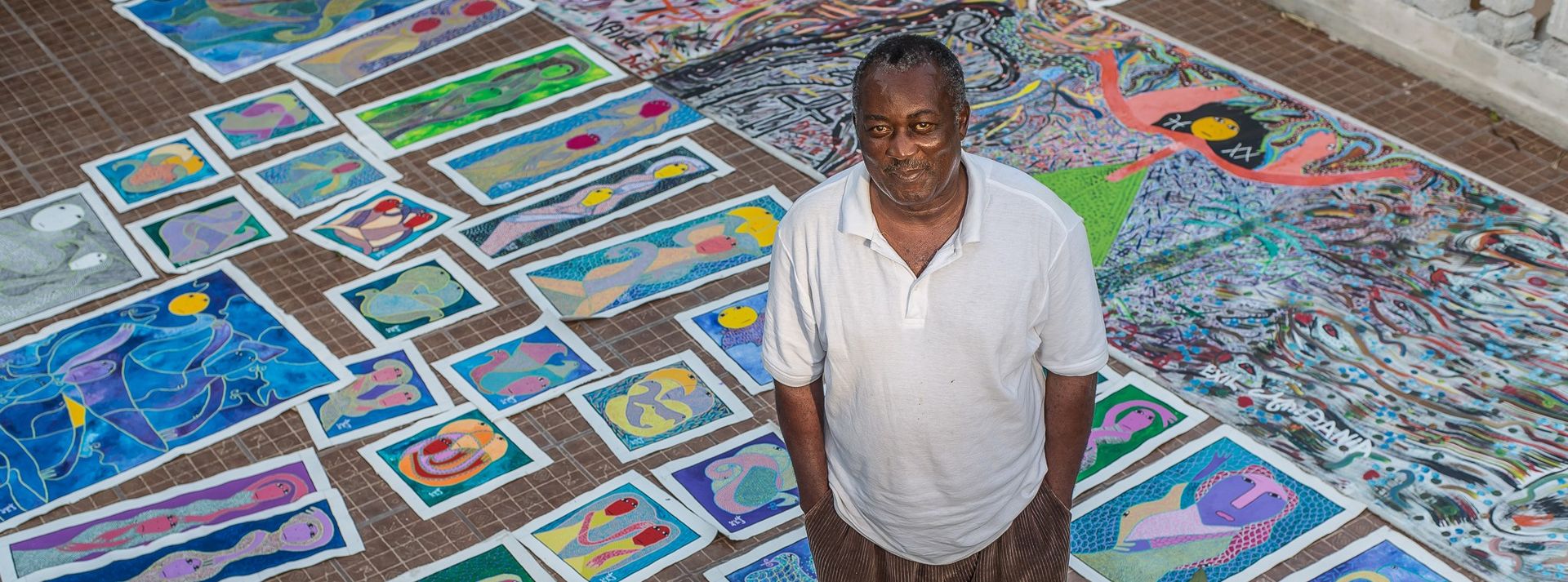
Saint Soleil — the Holy Sun — was an art community born in 1973 in Soisson-la-Montagne, a village in the mountains above Port-au-Prince, Haiti. It was founded by the painter Jean-Claude Garoute, known as Tiga, together with Maud Robart — not as an academy, but as a rural workshop where the people who farmed and worked the mountainside were handed brushes, paint, and canvas and invited to paint what they dreamed and what they saw in the Vodou spirits around them. Intuition was prized over training, feeling over formula. Out of that small mountainside experiment came one of the most admired and collected currents in all of Haitian art: a movement of suns, spirits, and astonishing color that changed what the world thought Haitian painting could be. Today, originals from the movement’s core group are among the most sought-after Haitian paintings on the market, and this gallery’s collection carries that lineage directly — from the mountains where it all began.
A community built on instinct
Tiga had first tried the idea in the Nénettes neighborhood of Pétion-Ville, near the capital, but the seed did not take. In 1973 he and Maud Robart moved the project up into the hills, to Soisson-la-Montagne, some twenty kilometers from Port-au-Prince, where they set up a working space and began with the people already there: masons, cooks, gardeners, peasant farmers. These were people with no academic training and no art world to please. Tiga’s conviction was that commerce had corrupted Haitian painting — that the market for easy copies of old masterpieces was producing mediocrity — and that the only honest art would come from hands painting their own inner life. So the farmers painted their dreams, their Loas, their suns. What emerged was a deliberate artistic choice: instinct as method. Robart, a dancer and intellectual, and Tiga, already an established painter, treated the villagers not as pupils to be corrected but as artists to be supplied: they lent a local space, brushes, and canvas — the tools — and deliberately stepped back from dictating what should appear on them. The point was never to teach the villagers to paint like professionals. It was to remove everything between a person and the canvas — training, fashion, the market — and see what came out.
Who were the Cinq Soleils?
From the wider Saint Soleil community, five painters stood out for their talent and commitment and formed an informal core group, calling themselves Les Cinq Soleils — the Five Suns. They were Levoy Exil, Prospère Pierre-Louis, Louisiane Saint Fleurant, Dieuseul Paul, and Denis Smith. Levoy Exil had begun painting in 1972 and joined the workshops in 1973; he remains the great living bearer of the movement’s spirit. The Five Suns gave Saint Soleil its public face, and today an original Haitian painting by one of them — especially an original from the movement’s heart — carries a weight in Haitian art history that few other names from the period can match. Louisiane Saint Fleurant’s work, like Exil’s, would later be traded in American and French galleries at prices those village painters could never have imagined when they first picked up a brush.
What made it radical
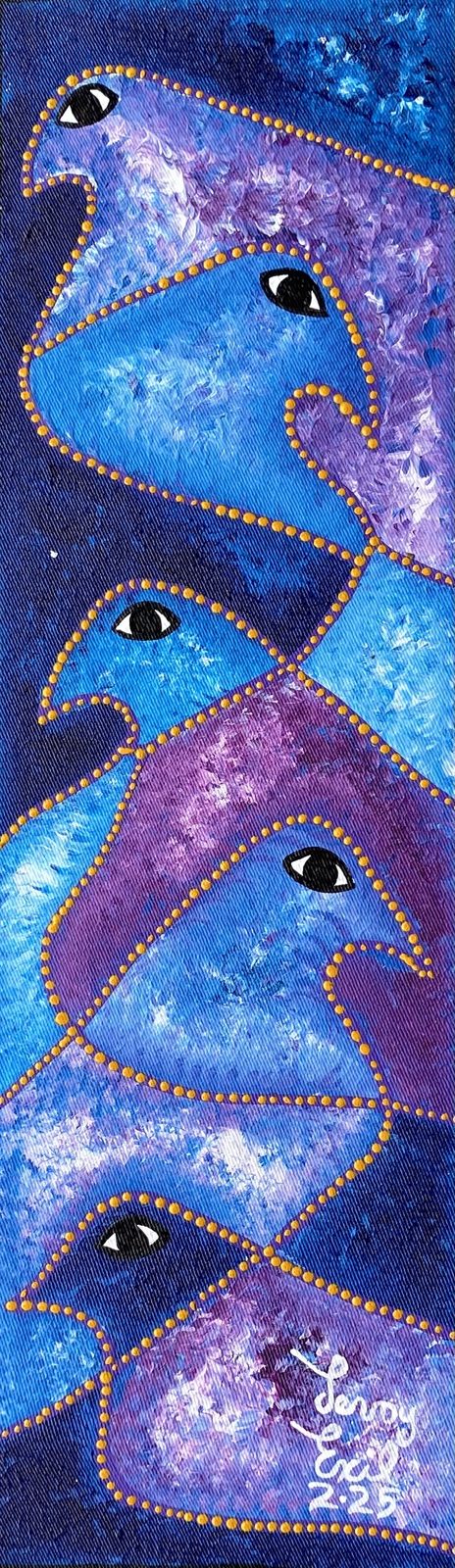
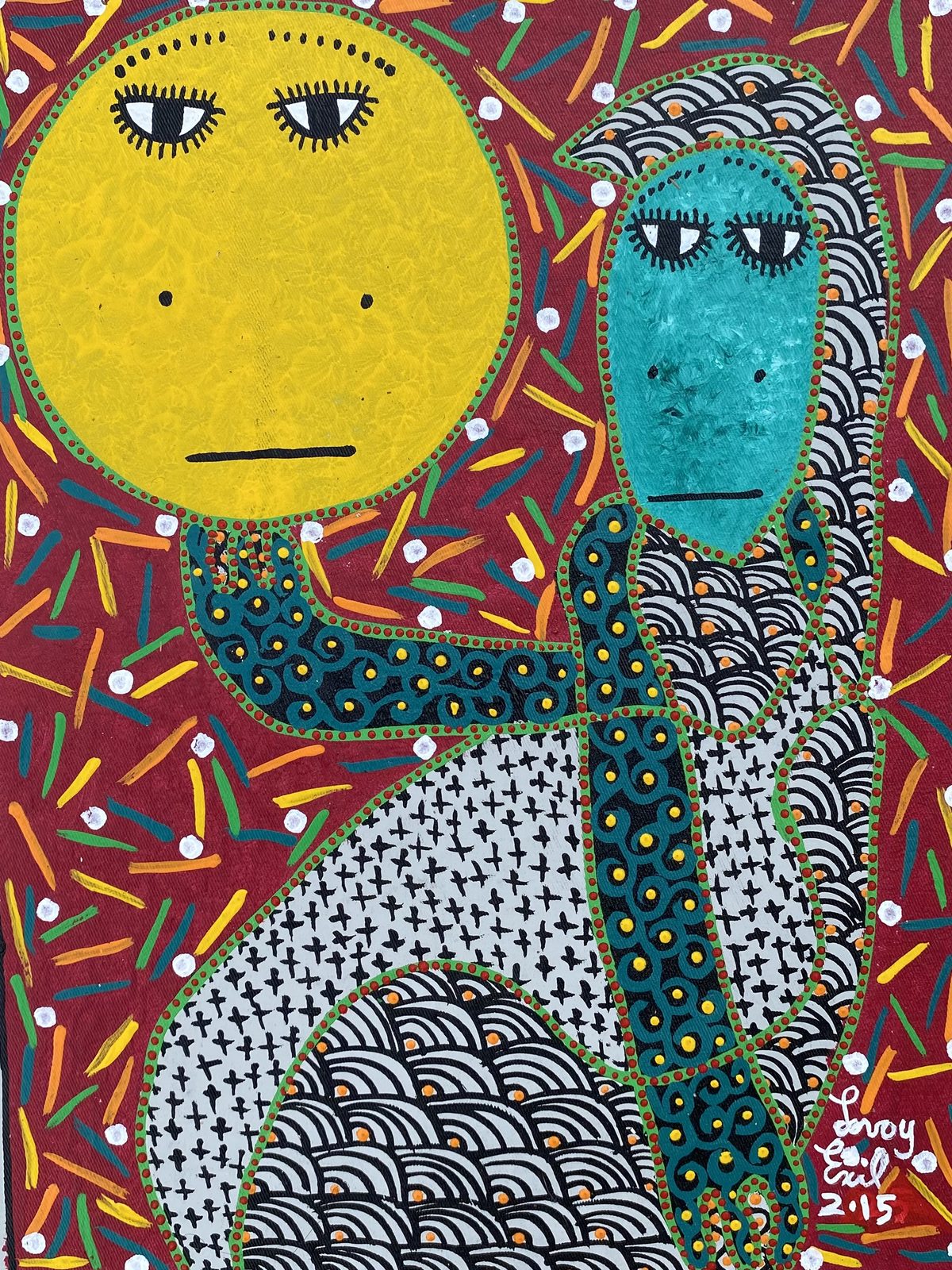
The radical part was not the subject matter — Haitian artists had painted Vodou themes before — but who was painting and how. Self-taught farmers were treated as serious artists. Intuition was explicitly favored over academic method. The painters worked as a community, sharing space and spirit, in the mountains rather than in the commercial galleries of Port-au-Prince. Their compositions grew dense and visionary: suns with faces, serpentine bodies, crowds of eyes, Loas emerging from fields of pointillist dots. Saint Soleil proved that the most powerful art could come from the most unexpected hands, and it permanently widened the map of who gets to be called a master. Tiga had said plainly that much of the painting being made for the market was mediocre — copies of old masterpieces made for quick sale — and Saint Soleil was his answer: art that owed nothing to the market and everything to the inner life. Nothing about the work was accidental or merely decorative: every canvas was a record of a dream, a spirit, or a vision its painter had actually lived with.
The Malraux visit
The world noticed. In 1975, the French novelist and statesman André Malraux traveled to the Saint Soleil community and was struck by what he found. He devoted a chapter of his final book, L’Intemporel, to the movement, writing the famous line: “Un peuple d’artistes habite Haïti” — a people of artists lives in Haiti. Levoy Exil’s artwork appeared on the cover of the book. Two years later, in 1977, Exil’s work appeared at the World Theater Festival in Nancy, France. The mountain workshop had become an international story, and its painters — farmers with no formal training — were being written about by one of France’s great intellectuals. For a community of mountain farmers to be taken seriously by a figure of Malraux’s stature was unprecedented, and it announced to the art world that something genuinely new was happening in Haiti. He was not the first French intellectual to take Haitian painting seriously, but his chapter gave the mountain farmers something no gallery could: a place in the story of world art.
Five decades of the Holy Sun
More than fifty years on, the Saint Soleil fire is still burning. Levoy Exil, one of the original Five Suns, is still painting in the Fermathe mountains, still laying dot upon dot in the method he learned in the 1973 workshops. Generations of artists have carried the movement forward, and the name Saint Soleil remains shorthand for Haiti’s boldest art revolution: proof that a brush in an honest hand matters more than a diploma. The sun that gave the movement its name still rises over Soisson-la-Montagne — and it still rises, face and all, in Exil’s paintings. For the movement’s fortieth anniversary, a new generation of artists in Soisson-la-Montagne formed the Artists Association Saint-Soleil to carry the work forward — proof that Saint Soleil is not a closed chapter but a living tradition.
Why collectors care
For collectors of Haitian art, Saint Soleil is more than history; it is provenance with meaning. An original Haitian painting by Levoy Exil is not just a beautiful object — it is a direct link to the most storied movement in Haitian art, made by one of the Five Suns themselves, in the mountains where the movement was born. The gallery offers original works by the artist, each one hand-painted and one of a kind. To buy Haitian paintings from this lineage is to take home a living chapter of art history — one that, remarkably, is still being written. Collectors browsing Haitian art for sale will find many works in the style; few carry the weight of an original by one of the Five Suns, painted in the mountains where the movement was born.
Browse all of Levoy Exil’s originals in the gallery at /gallery/ — each work is a one-of-a-kind, hand-painted original. To enquire about a painting, message the gallery on WhatsApp or write to levoyexilgallery@gmail.com; the team will be glad to help with details, provenance, and pricing. International shipping is available, and the gallery ships worldwide, so a piece of Haiti’s Saint Soleil legacy can reach your walls wherever you live.