
November 1, 2026
What Do the Suns Mean? Decoding Levoy Exil's Symbols
Suns, Loas, eyes, birds, and a thousand dots: a respectful guide to the symbols in Levoy Exil’s paintings and how collectors read the language of Saint Soleil.
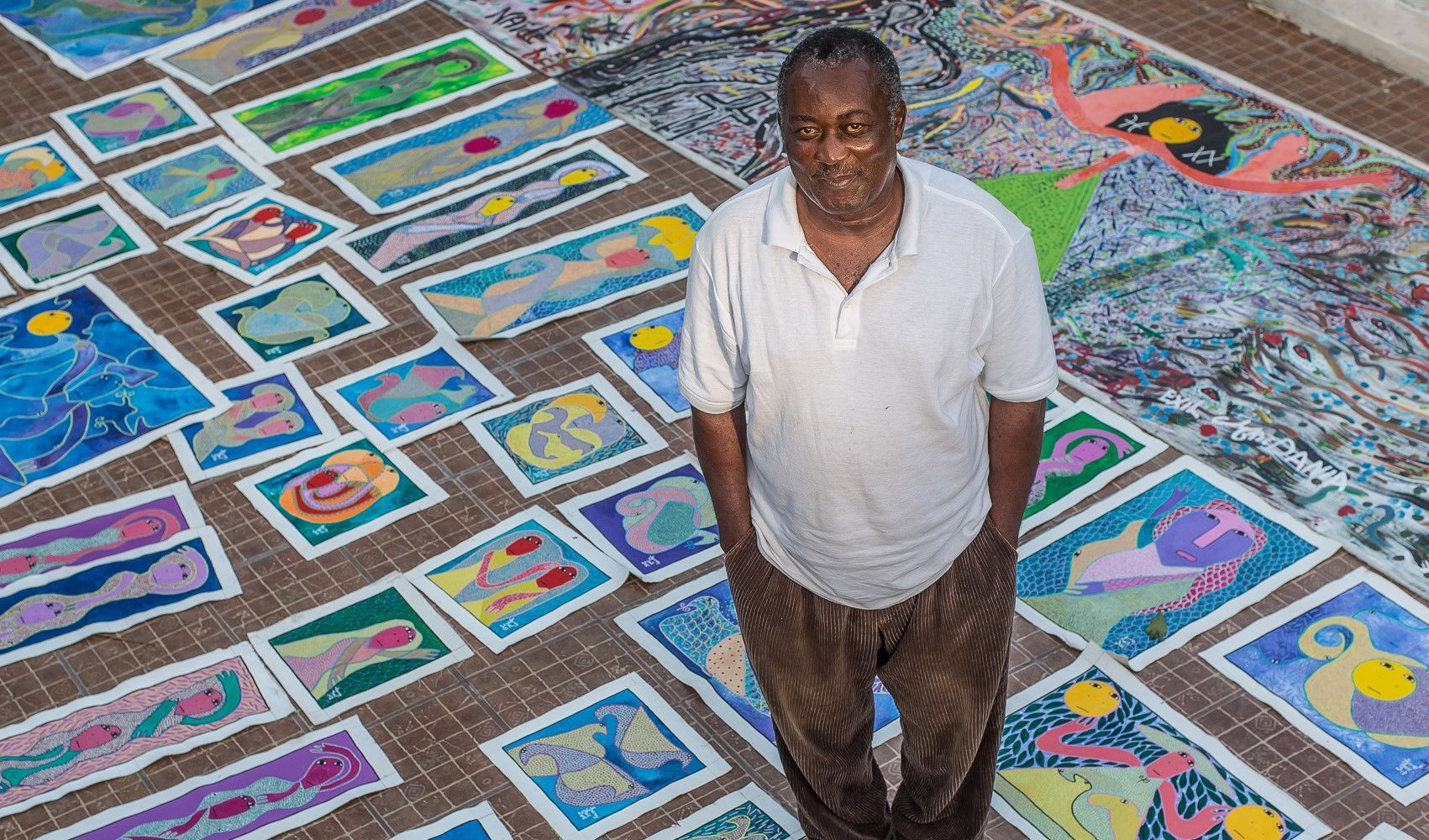
What do the suns mean in Levoy Exil’s paintings?
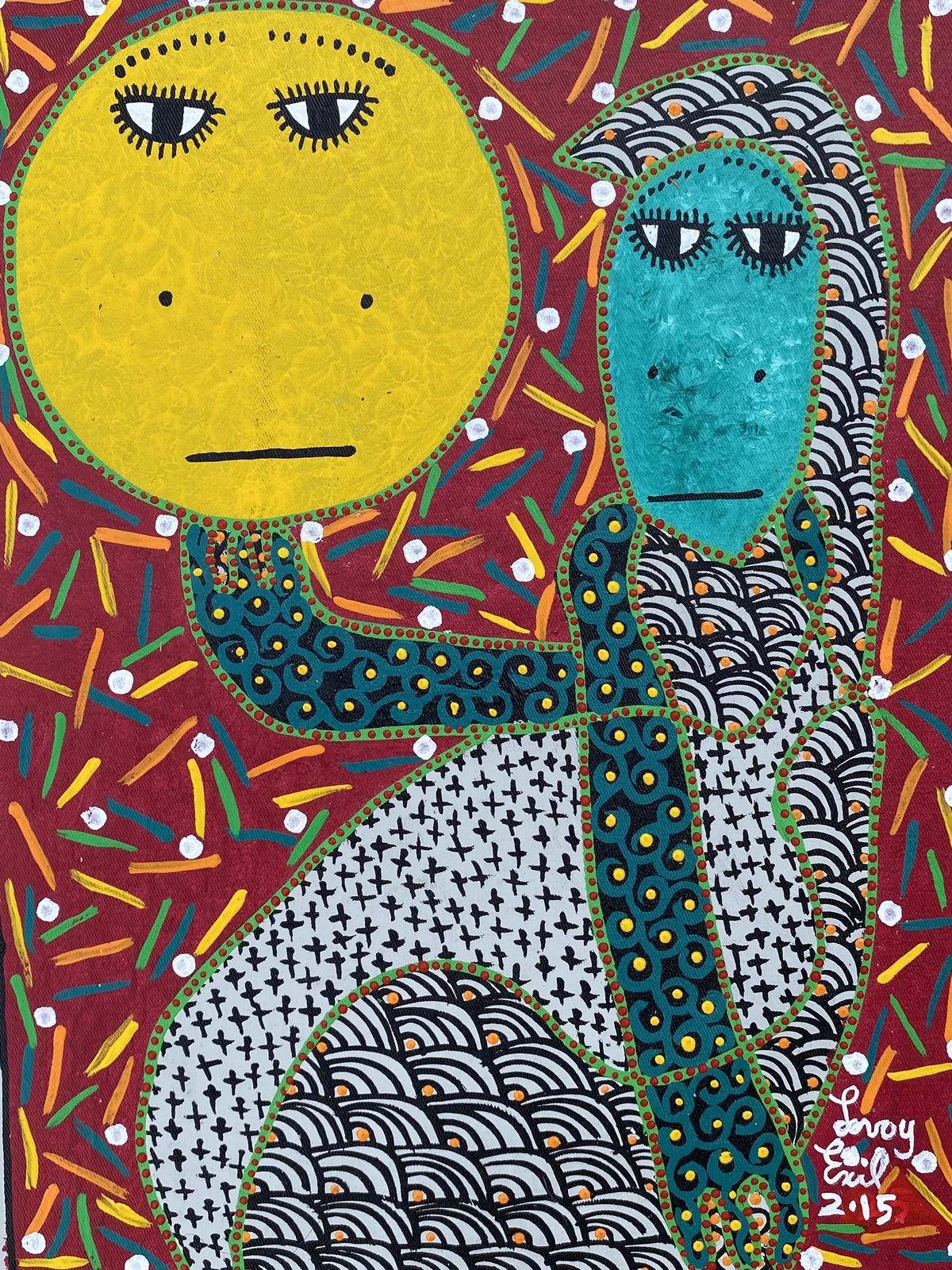
The suns are the first thing most viewers notice — radiant faces glowing out of dense fields of color — and they are everywhere in Levoy Exil’s work. They are the signature of the Saint Soleil movement itself: the Holy Sun. For Exil, the sun is not decoration. It is the center of his visual language, the motif that ties five decades of painting together, and the reason collectors speak of his canvases as glowing. Ask what the suns mean, and you are really asking what Saint Soleil means: light, presence, and a spiritual world that is always close. Newcomers to Haitian art sometimes ask whether the suns are religious symbols or decoration. The truth is simpler and deeper: for Exil they are the home key of everything he paints, the note every composition returns to. Once you see the suns as presences rather than pictures, the rest of the painting opens up: the eyes, the birds, the spirits all start to feel like company the sun is keeping.
The sun as unity
Exil’s most famous sun painting is “Solrou: The Sun’s creates Unity” — the canvas that, in 2023, inspired Gabriela Hearst’s Spring Summer 2024 collection. The title says what the suns mean to him: the sun creates unity. It gathers. It holds things together — spirits, people, colors — in one radiant field. That is how collectors read the suns in his work: not as astronomical bodies but as presences, faces of light that watch over the painting’s crowded spiritual life. The movement took the sun for its name; Exil took it for his creed. Look at how the sun is treated in a painting like Famousol — a golden face on a deep red field, calm at the center of everything around it. That centered calm is the point.
Loas: the spirits in the paint
Move through a Levoy Exil canvas and you will meet the Loas — the spirits of Haitian Vodou, the intermediaries between the human and the divine. Exil does not illustrate them the way an outsider might; he paints them as presences he knows, crowded and watchful, woven into the same dense surface as the suns and birds. This is where respect matters: for Exil, these are not fantasy creatures. They belong to a living spiritual tradition, and his paintings are best approached the way one approaches that tradition — with attention and humility, not with a decoder ring. You do not need to know the names of the Loas to feel their presence in a painting — but knowing that they are honored spirits, not inventions, changes how you look. He paints them crowded together the way they are honored together — not as isolated figures but as a living assembly, which is exactly how his densest compositions feel.
Eyes that watch back
Then there are the eyes — dozens of them, sometimes hundreds, looking out from the canvas in every direction. In Exil’s paintings, nothing is inanimate; the whole surface seems awake. Collectors often say the same thing about standing in front of one: the painting looks back at you. Read them as the gaze of the spirit world, or as the artist’s own watchfulness over his work — either way, they are why his paintings feel less like pictures and more like presences. The eyes are what make a room change when one of his canvases goes up on the wall. Some collectors say the eyes are the reason they bought the painting: once you have felt a canvas watching you, flat decoration will never satisfy you again. They are the most human thing in the paintings: everything else may be spirit or symbol, but the eyes are simply looking, the way a person looks.
Birds between worlds
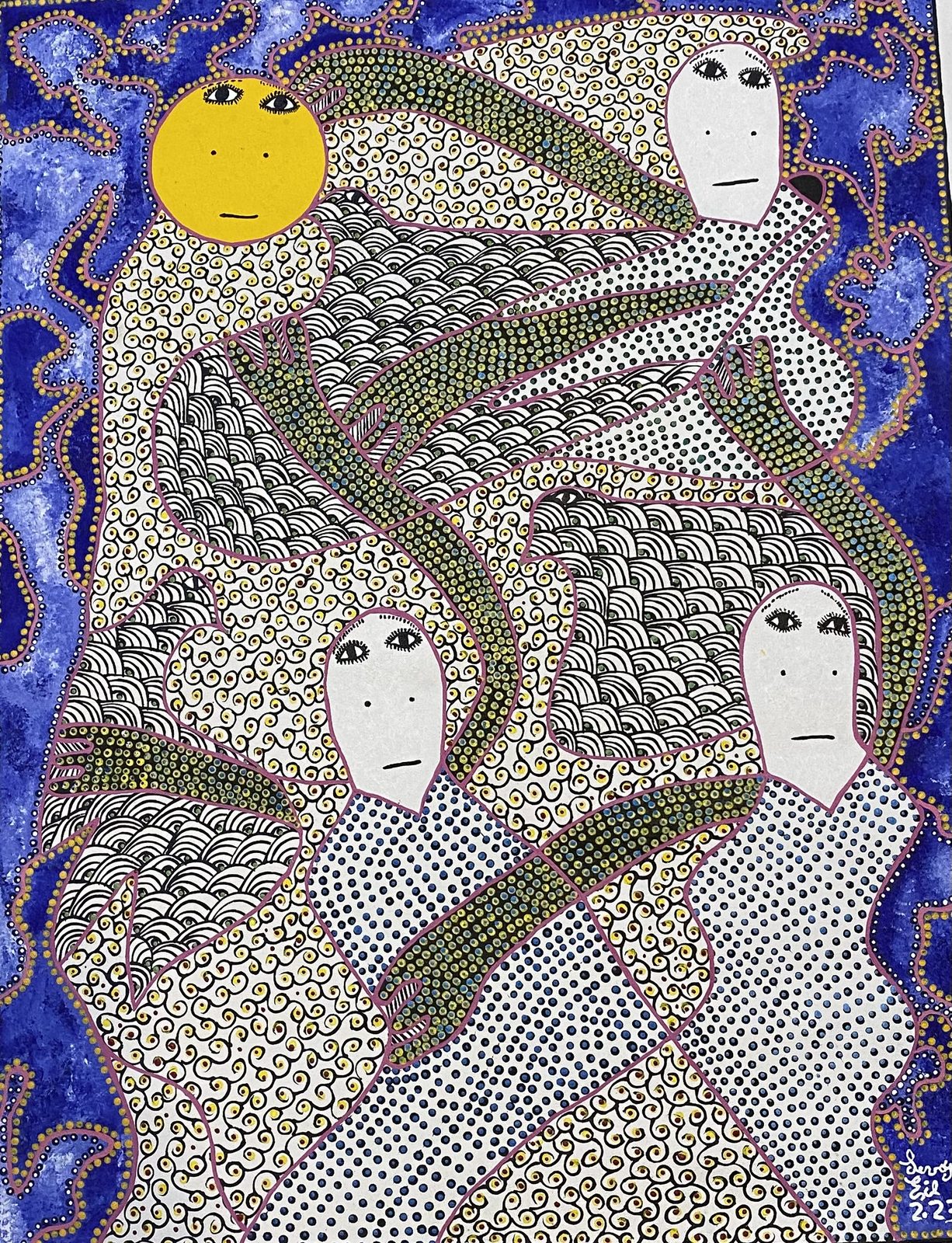
Birds recur constantly in Exil’s work — perched, circling, woven into the bodies of larger spirits. One of his auction-recorded works is even titled “Figure with Doves.” For many viewers, the birds feel like messengers, moving between the world of the painting’s spirits and the world of the person looking at it. Whether or not you read them that way, they give his compositions their airiness: against the density of the dot work, the birds are the moments of lift, the parts of the painting that seem about to take flight. In a visual language of heavy, crowded forms, the birds are breath.
Serpentine forms
Undulating bodies wind through his canvases — the serpentine figures of paintings like Foksou, blue and violet forms outlined in gold dots, coiling through fields of color. In Haitian spiritual life the serpent carries deep resonance, and in Exil’s hands these forms become pure movement: rivers of paint that tie the composition together, carrying the eye from sun to spirit to bird. They are some of his most sensual passages, and a good reminder that his symbolism is never rigid — it flows. Follow one serpentine line with your eye across the canvas and you will find it connects everything — sun to spirit, spirit to bird — like a current running through the work.
The language of dots
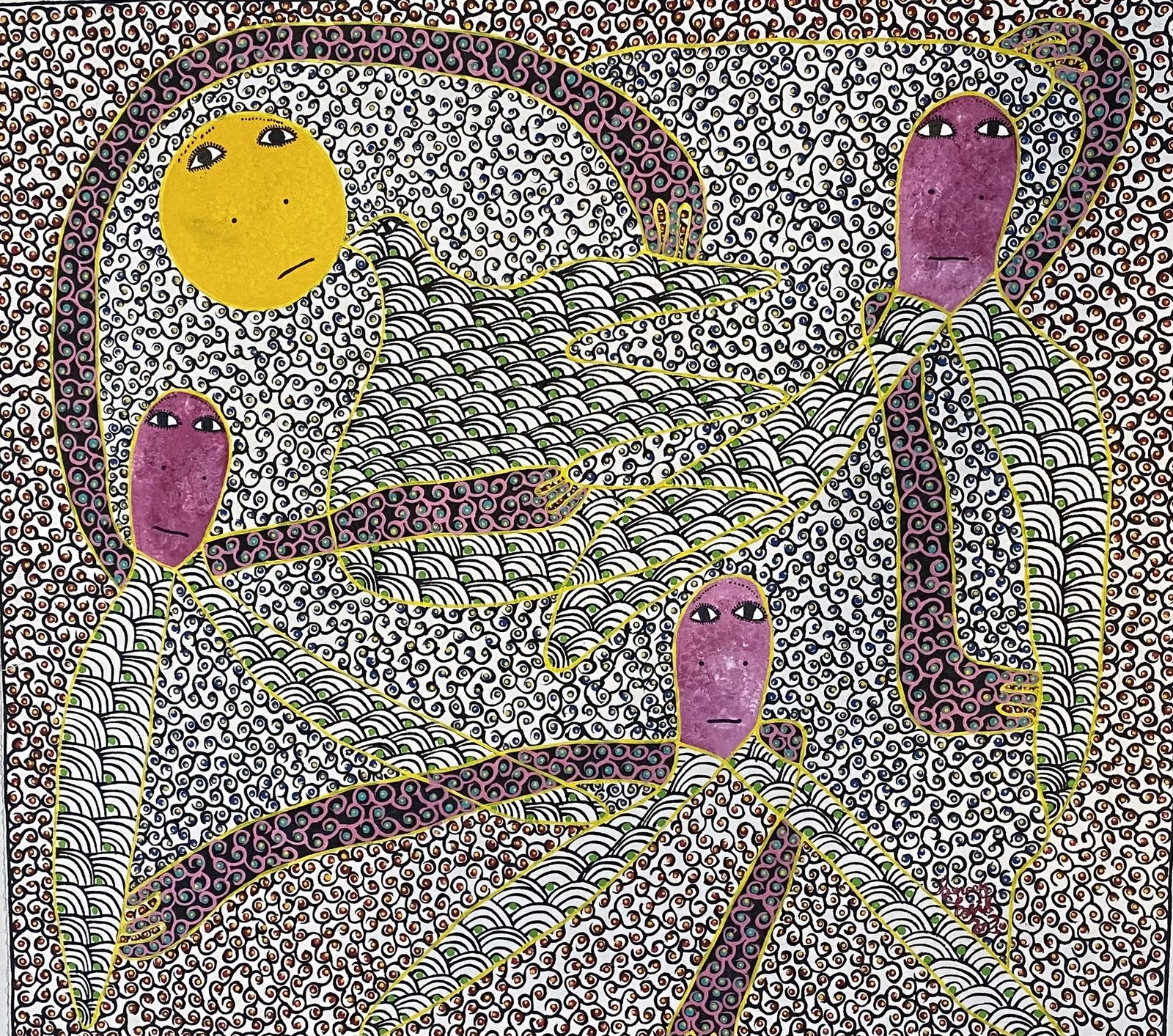
Underneath every symbol is the method: thousands upon thousands of tiny dots, laid down one by one in a pointillist technique that is unmistakably Exil’s. The dots are not just texture — they are the atmosphere of his world, the way light shimmers, the way spirits materialize out of color. A single canvas can represent long stretches of this patient work. When collectors speak of the “glow” of an Exil painting, they are speaking of the dots: no printer can reproduce what thousands of hand-laid points of paint do to light. Stand close and the painting dissolves into points of color; step back and the suns and spirits reassemble. That double vision is the signature of the method. It is slow work, and the slowness shows: there is a patience in the surface that no fast process can imitate, and collectors learn to recognize it the way you recognize a voice.
How collectors read a Levoy Exil painting
The honest answer is that no single reading is correct. Exil’s symbols form a visual language, not a code — you learn it by looking, the way you learn a face. Spend time with a canvas and the suns, eyes, birds, and serpentine forms start to feel familiar, like characters in a story you are being told rather than puzzles to solve. The gallery’s close-up photographs help: study the dots, follow a serpentine line, meet the eyes one by one. And remember that every original is one of a kind — the language is his, but each painting says something only it can say. If you are choosing your first Exil, start with the painting that keeps pulling your eye back. The symbols will teach themselves to you over years of living with the work. Hang it where you will see it every day, and let the looking do the teaching — that is how the collectors who love his work the most all describe learning it.
Browse all of Levoy Exil’s originals in the gallery at /gallery/ — each work is a one-of-a-kind, hand-painted original. To enquire about a painting, message the gallery on WhatsApp or write to levoyexilgallery@gmail.com; the team will be glad to help with details, provenance, and pricing. International shipping is available, and the gallery ships worldwide, so the suns of Saint Soleil can rise on your walls wherever you live.